10 Weeks In: Why I'm Not Waiting for Side Income Anymore

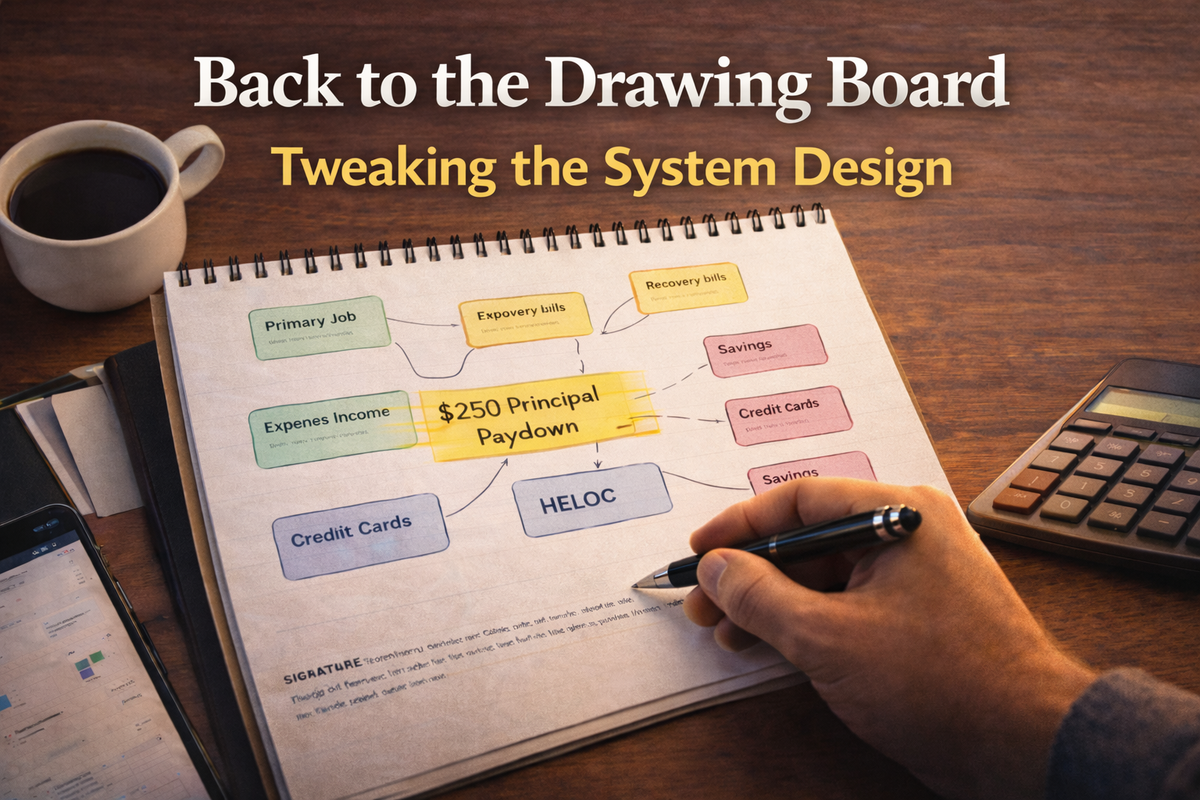
The system is working. The timeline isn't. Here's what's changing — and why.
I'm 10 weeks into running this HELOC paydown system.
The weekly cycle is holding. The options account is growing. The classifications are consistent. The structure is there.
But progress on the HELOC balance itself has been slower than I expected — and waiting indefinitely for side income streams that haven't materialized yet isn't a strategy. It's a hope.
So starting in May, the approach shifts.
The Original Plan
From the beginning, the plan was clear:
Pay only the minimum on the HELOC until one of two things happened:
- The options account reached $50,000 and could cover the minimum payment with premium income
- A separate side income stream started producing consistently enough to replace paycheck dollars
Once either of those conditions was met, the cash that was coming from W-2 income to cover the HELOC minimum would shift to principal instead. All progress on the balance would come from new income, not from cutting discretionary spending or tightening the budget.
No lifestyle changes. No sacrifices. Just layered income doing the work.
That was the vision.
What Actually Happened
The system ran every week. The structure held.
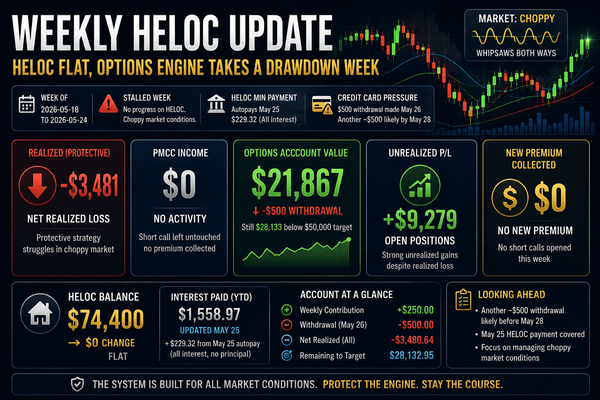
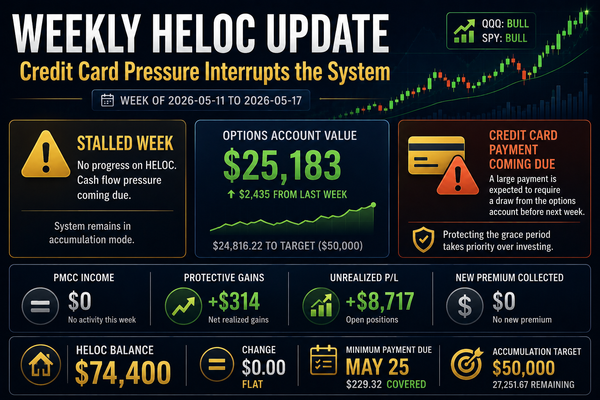
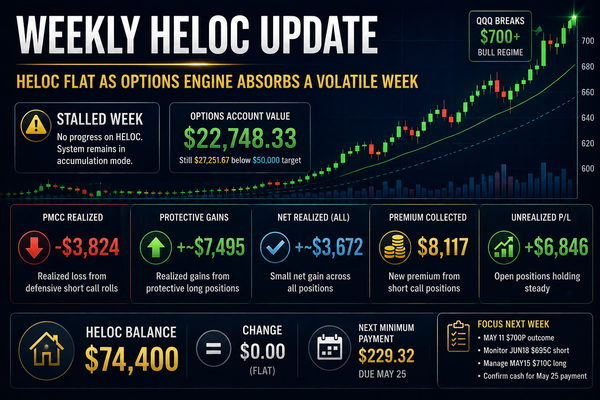
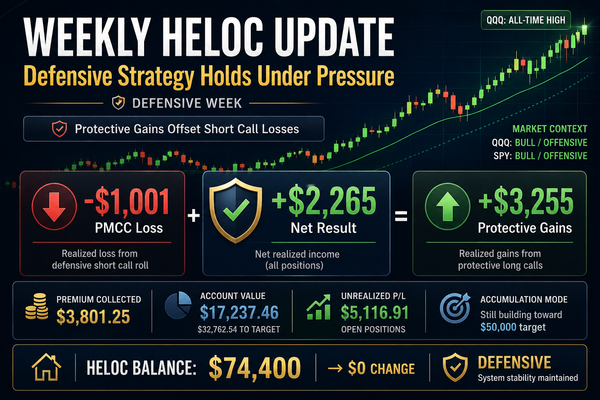
The options account grew — from zero to approximately $12,500. Contributions have been consistent: $125 per week initially, now $250 per week. Premium income is real, though the path hasn't been linear. Market volatility hit. Drawdowns happened. The account took a step back before moving forward again. That's how options strategies behave in real conditions.
At the current contribution rate, plus premium reinvestment, the $50,000 threshold is roughly 3 to 4 years out under stable market conditions. Longer if the market doesn't cooperate.
Side income outside of options? Nothing consistent yet. Efforts are ongoing, but there's no revenue to report. No income to track. No stream that's proven itself over multiple cycles.
HELOC progress? Minimal. A few opportunistic payments when surplus cash was available — a tax refund here, a bonus there. But no sustained momentum. The balance has barely moved.
The weekly process is working. The balance isn't.
The Problem
Waiting 3 to 4 years for the options account to hit $50K before making any real progress on the HELOC isn't viable.
Here's why:
The interest cost is real. At 7.5%, the HELOC costs roughly $465 per month — over $5,500 per year. That's cash leaving the system every month, working against a balance that isn't shrinking fast enough to offset it.
The renovations are coming. Phase 1 work — replacement windows, stucco, siding, exterior paint — is planned for late summer. The balance is going to go up before it comes down. If there's no principal momentum before the draws happen, the system will be starting from an even higher number afterward.
Side income hasn't proven itself yet. I can't build a plan around income that doesn't exist. The efforts are real. The results aren't. And assuming they'll materialize on a timeline that aligns with the HELOC paydown schedule is optimistic projection, not system design.
The original plan made sense in theory. In practice, it's become clear that waiting for either condition — $50K in the options account or consistent side income — means the HELOC sits largely untouched for years while interest continues to accrue.
That's not acceptable.
The Adjustment
Starting in May, the system shifts to a structured principal payment schedule funded by W-2 income.
Here's how it works:
First Friday of each month: Minimum payment (automated, non-negotiable)
Remaining Fridays of the month: At least one $250 principal payment (guaranteed minimum for the month)
Additional principal payments on the other Fridays will be evaluated weekly based on:
- Upcoming bills within the next 30 days
- A $500 checking account buffer (soft floor, not a hard rule — timing of the next paycheck matters)
If conditions allow for more beyond that guaranteed $250, it goes. If conditions are tight, at least one $250 payment still happens.
All payments — minimum and principal — are funded by W-2 income. For now.
The New Milestone Structure
The goal isn't to replace side income. It's to build toward replacing the W-2 allocation with side income as it proves itself.
The milestones are stacked:
Milestone 1: Side income covers one $250 principal payment per month
When that happens, one Friday's $250 payment shifts from W-2 income to side income. The paycheck dollar that was covering that payment becomes available for something else — either additional principal or reinvestment into the next income stream.
Milestone 2: Side income covers two $250 principal payments per month
Another Friday shifts. Another paycheck dollar gets freed up.
Milestone 3: Side income covers all principal payments beyond the minimum
At this point, the W-2 is only covering the HELOC minimum. Everything beyond that is coming from income the system generated, not income I traded time for.
The options account milestone doesn't change: It still needs to reach the level where premium income can cover the HELOC minimum payment. That becomes even more critical once Phase 1 renovations increase the balance and, with it, the size of that minimum.
Why This Isn't Abandoning the Plan
This adjustment doesn't replace the original strategy. It hedges against it taking longer than expected.
The long-term vision is still the same: multiple income streams contributing to HELOC paydown, reducing how much the W-2 paycheck has to carry, building a system that outlasts the balance.
What's changing is the timeline assumption. The original plan assumed side income would materialize soon enough that waiting made sense. Ten weeks in, that assumption hasn't held. The system is adapting to the reality on the ground, not the projection on paper.
If side income starts flowing — great. It offsets the W-2 principal payments, and the balance drops faster. The paycheck dollars that were going to principal get redirected to the next engine.
If it doesn't — at least the balance is moving. The HELOC isn't sitting static for years while interest accrues and the options account slowly builds toward $50K.
What This Means for the Weekly Cycle
The 6-step process doesn't change:
- Observe the cash position
- Confirm obligations are covered
- Run the HELOC layer (minimum + principal payments)
- Run the options engine
- Layer in additional income
- Classify the week
Step 3 is the only thing that shifts. Instead of opportunistic principal payments when surplus cash happens to be available, there's now a structured floor: at least $250 per Friday beyond the first (which covers the minimum).
The classification structure stays the same:
- Progress: Extra principal was made
- Defensive: Minimum paid, buffer held, no extra principal (conscious decision based on known constraints)
- Stalled: Week fell through without a clear result
The difference is that Progress weeks should now be more frequent — because principal payments are part of the structure, not dependent on windfalls.
The Honest Assessment
I've been consistent. The system runs every week. The options account is growing.
But I've also been overly confident that side income would start flowing sooner than it has. Ten weeks isn't enough time to judge long-term results — but it's enough time to recognize when an assumption isn't holding.
The assumption was: side income will materialize before the HELOC needs sustained principal momentum.
The reality is: the HELOC needs momentum now, and side income hasn't proven itself yet.
So the system adjusts. I start chipping away at principal with W-2 income, with the goal of replacing that W-2 allocation as side income comes online. The paycheck covers it now. The engines replace it later.
That's the hedge. And it's the right call.
What's Next
First principal payment under the new structure: First Friday in May after the minimum payment
Target: At least one $250 principal payment in May, with additional payments evaluated weekly
Tracking: Weekly updates will continue as usual, now showing both minimum and principal payments separately
The options account contributions stay at $250 per week. The weekly cycle continues. The renovations move forward on schedule.
The only difference is that the HELOC balance will start moving — consistently — instead of waiting for conditions that might not arrive on the timeline the system needs.
If you're new here, start with how the system works or the refinance update.